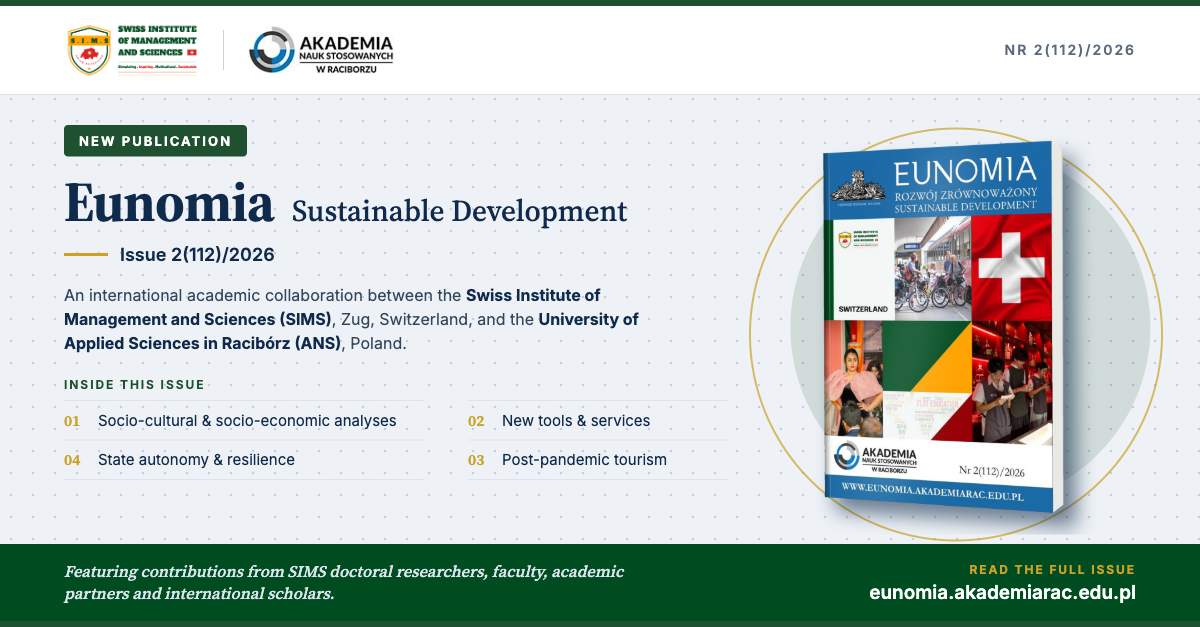
The latest issue of Eunomia – Sustainable Development, Issue 2(112)/2026, is now available online. This edition marks an important milestone in the ongoing academic collaboration between the Swiss Institute of Management and Sciences (SIMS), Zug, Switzerland, and the University of Applied Sciences in Racibórz (ANS), Poland.
The issue brings together scholarly contributions from SIMS doctoral students, faculty members, academic partners and international researchers from Italy, Croatia, Switzerland, the United Kingdom and other countries. It reflects the value of cross-border academic engagement in addressing contemporary challenges in sustainable development.
Through this collaboration, researchers contribute perspectives from different disciplines, geographical contexts and professional backgrounds, creating opportunities for knowledge exchange and broader scholarly discussion.
About Eunomia – Sustainable Development
Eunomia – Sustainable Development is an academic journal published by the University of Applied Sciences in Racibórz. Since 2018, the journal has provided an academic platform for research on the social, economic and institutional dimensions of sustainable development.
With its interdisciplinary orientation, the journal brings together perspectives from economics, management, the social sciences, tourism studies and public policy. Its international scope encourages researchers to examine development challenges through different theoretical approaches and practical experiences.
Issue 2(112)/2026 further reflects the journal's commitment to international academic engagement and the exchange of research across national and disciplinary boundaries.
Strengthening International Academic Collaboration
The cooperation between SIMS and ANS reflects a shared commitment to advancing research, strengthening academic networks and promoting international knowledge exchange.
By combining the academic expertise, research interests and international connections of both institutions, the partnership creates opportunities for faculty members, doctoral researchers and academic partners to engage with a wider scholarly community.
A key dimension of this collaboration is its international and interdisciplinary character. Contributions to the current issue draw on research contexts from Vietnam, Cambodia, India, Switzerland and other countries, connecting regional experiences with broader discussions on sustainable development. This exchange of perspectives strengthens the international dimension of academic research and encourages dialogue between European and Asian scholarly communities.
The collaboration also acknowledges the contributions of SIMS Chancellor Prof. Dr. Aleksandra Zając, ANS Rector Dr. Paweł Strózik, Editor-in-Chief Piotr Mucha, the journal's Scientific Board, and the authors.
Inside This Issue
Issue 2(112)/2026 brings together research on the social, economic and technological dimensions of sustainable development, organised into four thematic areas:
- Socio-cultural and Socio-economic Analyses: gender and identity, perceptions of failure in high-stakes language examinations, business hubs and student careers, and consumer nationalism.
- New Tools and Services: parcel lockers in urban logistics, artificial intelligence in stock investment, and sustainable consumption.
- Post-Pandemic Tourism: the resilience of domestic tourism and changing traveller priorities after COVID-19.
- State Autonomy and Resilience: digital autonomy, emerging risks and governance frameworks.
With case studies from Vietnam, Cambodia, India and Switzerland alongside wider European research, the issue offers a comparative, international perspective on development challenges.
Access the Publication
The full issue of Eunomia – Sustainable Development, Issue 2(112)/2026, is available online:
- Full Issue (PDF): Eunomia 2(112)/2026
- Journal Website: eunomia.akademiarac.edu.pl
SIMS extends its congratulations to all contributing authors and expresses its sincere appreciation to the University of Applied Sciences in Racibórz, the editorial team and the Scientific Board of Eunomia – Sustainable Development.
We look forward to further strengthening this academic partnership and expanding opportunities for international research collaboration, scholarly exchange and contributions to sustainable development.